
![존재와 시간 [제2판] Sein und Zeit](https://cdn11.bigcommerce.com/s-6r7pgwu3ae/images/stencil/600x600/products/3141/3772/9788972918677__37207.1769298623.jpg?c=1 "존재와 시간 [제2판] Sein und Zeit")
![존재와 시간 [제2판] Sein und Zeit](https://cdn11.bigcommerce.com/s-6r7pgwu3ae/images/stencil/1280x1280/products/3141/3772/9788972918677__37207.1769298623.jpg?c=1 "존재와 시간 [제2판] Sein und Zeit")
Product Overview
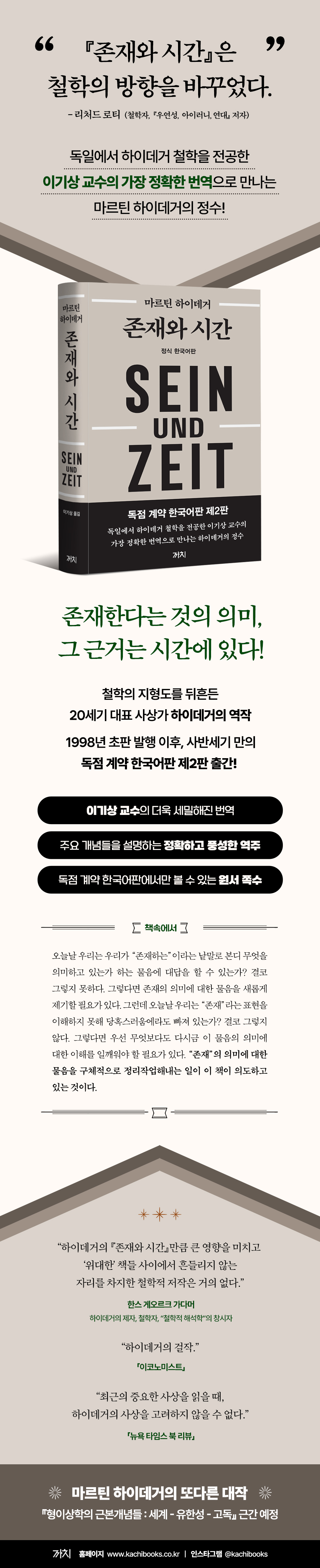
20세기의 대표적인 철학자 마르틴 하이데거의 역작-제2판 개정판
『존재와 시간』이 독일에서 1927년에 처음으로 출간된 즉시 하이데거는 철학의 최전선에 섰으며, 철학사의 새로운 이정표를 세웠다는 평가를 받았다. 철학을 넘어 오늘날의 문학, 예술, 언어 등 문화 전반에 결정적인 영향을 미친 현대의 고전이자 필수 원전으로 자리매김한 이 책은 철학자들은 물론 대중에게도 널리 읽히며 오랜 사랑을 받았다.
제2판은 1998년 초판을 번역하며 이 명저를 국내에 소개함과 동시에 한국 철학계에도 한 획을 그었던 한국외국어대학교 이기상 명예교수가 독일의 데 그루이터(De Gruyter) 출판사의 2006년 제19판을 기준으로 전문을 세심하게 살피고 문장들을 가다듬었다. 특히 이번 제2판에서는 존재를 사건으로서, 즉 동사형으로 이해하려는 시각으로, “존재”라는 표현 대신에 “있음”, “있다”라는 번역어를 택했으며, “세계-내-존재”라고 번역한 개념을 “세계-안에-있음”으로 옮겼다.
Being and Time, the monumental work of Martin Heidegger—one of the most influential philosophers of the twentieth century and widely regarded as one of the most important philosophical texts of that era—has been released in a second edition, featuring a refined translation and newly redesigned cover and interior. Upon its initial publication in Germany in 1927, Being and Time immediately placed Heidegger at the forefront of philosophy and was hailed as establishing a new milestone in the history of philosophical thought. This work, which has exerted a decisive influence not only on philosophy but also on modern literature, art, language, and culture at large, has become a modern classic and an essential primary text, read and cherished over many decades by both philosophers and general readers.
The second edition has been meticulously revised by Professor Emeritus Lee Gi-sang of Hankuk University of Foreign Studies, who first introduced this seminal work to Korean readers with the 1998 first edition and made a significant contribution to Korean philosophical scholarship in the process. For this revision, Professor Lee carefully reviewed the entire text and refined the translation based on the 19th German edition (2006) published by De Gruyter. Notably, this second edition adopts a perspective that understands Being as an event—that is, as something verbal rather than nominal—choosing the renderings “being-there” or “being” expressed as “being-ness” and “to be,” instead of the static noun “Being.” Likewise, the concept previously translated as “being-in-the-world” has been rendered as “being-in-the-world” in a more explicitly verbal sense, translated as “being-in-the-world” understood as “being-in-the-world-as-being-there,” emphasizing the dynamic nature of existence.

![희랍어 시간 [ 2024 노벨문학상 수상작가 한강 소설]Greek Lessons](https://cdn11.bigcommerce.com/s-6r7pgwu3ae/images/stencil/500x659/products/2664/3268/XL__44998.1729038113.jpg?c=1 "희랍어 시간 [ 2024 노벨문학상 수상작가 한강 소설]Greek Lessons")


